
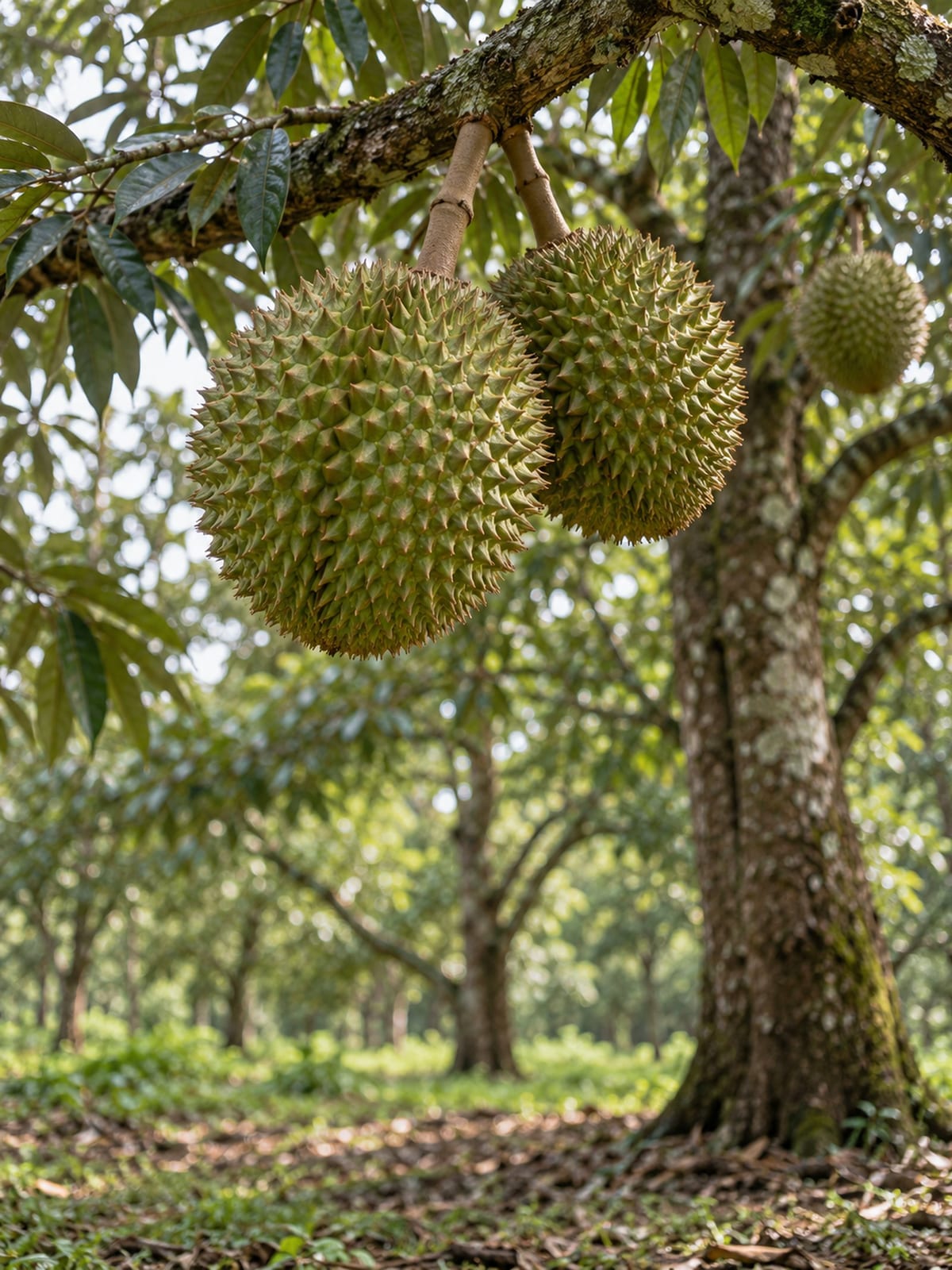
Fruits · Tall evergreen tree

Durian

Durio zibethinus · Durian · Malvaceae

A long-lived tree that starts bearing after several years. Phytophthora patch canker and root rot are the main threat, so drainage, clean grafted plants and an open canopy come first. Harvest is either by collecting naturally fallen fruit or cutting mature fruit for distant markets.

  • Humid tropics
  • Tree crop

Summary of cited sources. TERAknow summarises published guidance from the sources linked on each page. Recommendations are general, not guaranteed: results depend on your soil, climate and variety, so confirm with local extension staff or an agronomist before acting.

Key facts

Site and soil at a glance

Site
Below 800 m, 1,500 to 2,500 mm rain, 2 to 4 dry months[1]
Soil pH
6.0 to 7.0; solum deeper than 1.5 m[1]
Water table
Keep at least 80 cm below ground[2]
Spacing
10 x 10 m (Indonesia) or 11 x 11 m, 86 trees/ha (Sarawak)[1]
First crop
Vegetative period of 4 to 7 years[3]
Maturity
90 to 150 days after anthesis, by cultivar[4]
Soil pH band: 6.0 to 7.0
Good practice

Practices by growth stage

Pick a stage, topic or approach to narrow the list. Open a card for technical detail and its sources.

Growth stage
Topic
Approach

Showing 11 of 11 practices.

    • Core practice
    • Establishment
    • Stage: Planting

    Plant on raised mounds with good drainage

    Phytophthora palmivora thrives in wet soil. Avoid low-lying land and plant on mounds so roots stay above the water table.

    Technical detail
    • ACIAR: keep the water table at least 80 cm down. Mounds 50 to 60 cm high in deltas such as the Mekong, and 30 to 40 cm elsewhere.
    • Avoid planting on old rubber, cocoa or pawpaw land, which can carry the pathogen (ACIAR).
    • TFNet: do not grow durian in low areas with a high water table.
    Regions
    Vietnam · Thailand · Malaysia
    Confidence
    High confidence: several institutional sources agree
    • Core practice
    • Establishment
    • Stage: Planting

    Use labelled grafted plants and mix clones

    Grafted clones bear true to type. Planting more than one clone improves fruit set.

    Technical detail
    • Indonesian SPO: labelled grafted or budded plants 0.75 to 1.5 m tall, more than 6 months after budding. Holes 60 x 60 x 60 cm, or 100 x 100 x 100 cm in heavy soil. Keep the bud union above soil and shade for about 3 months.
    • Sarawak: plant a mix of clones with D99 as a pollinator. Listed clones include D24, D99, D123, D168 and local yellow types.
    • ACIAR: graft onto tolerant rootstock where known; resistance sources are not yet fully identified.
    Regions
    Indonesia · Malaysia
    Confidence
    High confidence: several institutional sources agree
    • Biological & regenerative
    • Soil biology
    • Stage: Canopy building

    Mulch the drip zone and use composted manure

    Organic mulch and well-fermented manure support soil life and root health. High inorganic nitrogen raises canker and root rot risk.

    Technical detail
    • ACIAR: mulch under the drip zone with straw and manure, but keep mulch off the trunk in the wet season.
    • Ferment green manure and chicken manure in planting holes for 8 to 10 weeks before planting; ACIAR mentions an EM starter culture.
    • TFNet adds lime and organic fertilizer to keep trees vigorous.
    Regions
    Vietnam · Thailand · Malaysia
    Confidence
    High confidence: several institutional sources agree
    • Conventional
    • Soil & nutrition
    • Stage: Canopy building

    Raise fertilizer with tree age, in small frequent doses

    Young trees get small, frequent doses. Rates rise as the trunk and canopy grow, and manure is applied alongside.

    Technical detail
    • Sarawak schedule: at planting 0.2 kg rock phosphate, 0.1 kg dolomite and 5 to 10 kg chicken manure; then compound fertilizer rising from 15:15:15 to 12:12:17:2+TE, and 20 to 40 kg chicken manure per tree per year.
    • Indonesian SPO: apply in a ring trench under the canopy, with organic fertilizer nearer the trunk.
    • These are rates from single guides; adjust to a soil or leaf test.
    Regions
    Malaysia · Indonesia
    Confidence
    High confidence: several institutional sources agree
    • Core practice
    • Crop care
    • Stage: Canopy building

    Prune for a clear trunk and an open canopy

    Removing low branches and opening the canopy improves airflow and keeps soil splash away from the tree.

    Technical detail
    • Indonesian SPO: start pruning at 1 year, keep the main trunk clear to 70 to 100 cm and form the canopy at 2 to 3 m.
    • ACIAR: remove branches within 80 to 100 cm of the ground and plant no more than 80 to 100 trees/ha.
    • Seal large cuts and disinfect tools between trees.
    Regions
    Indonesia · Vietnam · Thailand
    Confidence
    High confidence: several institutional sources agree
    • Biological & regenerative
    • Crop care
    • Stage: Canopy building

    Grow durian in mixed systems rather than dense monoculture

    Mixed cropping and diverse agroforestry lower disease pressure compared with uniform susceptible blocks.

    Technical detail
    • ACIAR advises against dense interplanting with other Phytophthora hosts such as papaya, coconut and cocoa.
    • TFNet recommends mixed cropping, weed control and 10 m spacing for airflow.
    Regions
    Widely applicable
    Confidence
    Medium confidence: one institutional guide
    • Core practice
    • Crop care
    • Stage: Flowering & pollination

    Support pollination at night

    Durian flowers open at night and are pollinated by night-flying animals and wind. Hand pollination can improve fruit set.

    Technical detail
    • Indonesian SPO: mix pollen with starch or flour at 3:7 and blow it onto flowers the same night. Store pollen at about 15°C if delayed.
    • Sarawak: a mixed planting of clones is needed to improve fruit set.
    Regions
    Indonesia · Malaysia
    Confidence
    Medium confidence: one institutional guide
    • Core practice
    • Pests & disease
    • Stage: Fruit growth

    Check trunks often and treat cankers early

    Patch canker shows as wet, dark bark lesions, often at the change from dry to wet season. Early action limits tree loss.

    Technical detail
    • Scrape lesions back to healthy wood and paint with a copper fungicide such as Bordeaux mixture (ACIAR) or a registered systemic product (Indonesian SPO, Sarawak).
    • Remove and burn badly infected or dead trees and lime the planting spot (TFNet).
    • Harvest fruit from the tree, not the ground, and bury or ferment infected fruit (ACIAR).
    Regions
    Indonesia · Malaysia · Thailand · Vietnam
    Confidence
    High confidence: several institutional sources agree
    • Conventional
    • Pests & disease
    • Stage: Fruit growth

    Phosphonate trunk injection for Phytophthora

    Trunk injection with neutralised potassium phosphonate is the main chemical tool tested in Southeast Asia.

    Technical detail
    • ACIAR: use phosphonate neutralised to pH 6.5 to 7.0. Mature trees received two or three injections a year during leaf flush, reduced to once a year as disease fell.
    • Inject in the morning and watch for bark splitting with high-pressure systems.
    • Use only products registered locally and follow the label.
    Regions
    Vietnam · Thailand · Australia
    Confidence
    High confidence: several institutional sources agree
    • Biological & regenerative
    • Soil biology
    • Stage: Fruit growth

    Beneficial microbes against Phytophthora

    Trichoderma fungi and Bacillus bacteria have been reported to reduce disease incidence. Use them alongside drainage and sanitation, not instead of them.

    Technical detail
    • The TFNet report mentions observations rather than field trial rates. Local evidence is limited.
    Regions
    Malaysia · Widely applicable
    Confidence
    Emerging evidence: early or small-scale evidence
    • Core practice
    • Harvest
    • Stage: Harvest

    Choose fallen-fruit or cut harvest to suit the market

    Naturally fallen fruit has the best eating quality but keeps only a few days. Cutting mature fruit gives slower ripening for distant markets.

    Technical detail
    • TFNet: Malaysian growers mostly collect fallen fruit; Thai growers mostly cut at maturity. Fallen fruit keeps 2 to 3 days at 25 to 30°C.
    • Indonesian SPO: tie fruit to a branch about a month before maturity, cut at 80 to 85% maturity about 1.5 cm from the branch, and lower fruit on rope.
    • In a Thai 'Monthong' study, fruit cut at 120 days after anthesis ripened close to tree-ripe quality; fruit cut at 110 days was poorer.
    Regions
    Malaysia · Thailand · Indonesia
    Confidence
    High confidence: several institutional sources agree
Regional notes

How practice differs by region

  • Malaysia

    Growers mostly collect naturally fallen fruit. Sarawak recommends 11 x 11 m spacing, mixed clones with D99 as pollinator, and chicken manure with compound fertilizer.

  • Thailand and Vietnam

    Fruit is mostly cut at maturity for export. ACIAR-backed work promoted mounds, mulch and phosphonate trunk injection against Phytophthora.

  • Research gap

    Indonesia

    The Ministry SPO covers site, grafted plants, pruning, hand pollination and harvest. Current Indonesian clone lists and Phytophthora rates are still to be added.

Common mistakes

What to avoid, and what to do instead

  • AvoidPlanting in low, wet ground.
    InsteadUse raised mounds and keep the water table at least 80 cm down.
  • AvoidPiling mulch against the trunk in the wet season.
    InsteadKeep mulch in the drip zone and away from the bark.
  • AvoidPlanting a single clone.
    InsteadMix clones, including a good pollinator.
  • AvoidIgnoring small bark lesions.
    InsteadInspect trunks often and treat cankers as soon as they appear.
  • AvoidSending fallen fruit to distant markets.
    InsteadCut mature fruit for long transport; sell fallen fruit locally within 2 to 3 days.
Sources

Numbered sources

This page summarises the sources below. Check the original documents for full context.

  1. Standar Prosedur Operasional (SPO) Penerapan Sistem Jaminan Mutu: Durian (opens in a new tab)Direktorat Tanaman Buah, Ditjen Bina Produksi Hortikultura, Kementerian Pertanian RI, 2002
  2. Integrated management of Phytophthora diseases of durian: recommendations and benefit-cost analysis (Ch. 8.7, ACIAR Monograph 114) (opens in a new tab)D.I. Guest, Nguyen Minh Chau, S. Sangchote, L. Vawdrey, Y. Diczbalis; ACIAR, 2004
  3. Durian (opens in a new tab)Jabatan Pertanian Sarawak (DOA Sarawak), from 9MP Fruit Industry Development Programme, 2006
  4. Durian: harvest and postharvest handling (opens in a new tab)International Tropical Fruits Network (TFNet) with Common Fund for Commodities, undated
  5. Technical op-ed: Durian cultivation faces serious threat from disease caused by Phytophthora sp. (opens in a new tab)Yacob Ahmad, International Tropical Fruits Network (TFNet), 2018
  6. Quality comparison of naturally and artificially ripened 'Monthong' durian fruits harvested at various maturity stages (opens in a new tab)P. Youryon and S. Supapvanich, Current Applied Science and Technology 22(6), 2022
THE NEXT STEP
LET'S CULTIVATE PROGRESS

Better soil starts
with better decisions.

Turn soil insights into practical action, from testing to targeted improvement.