
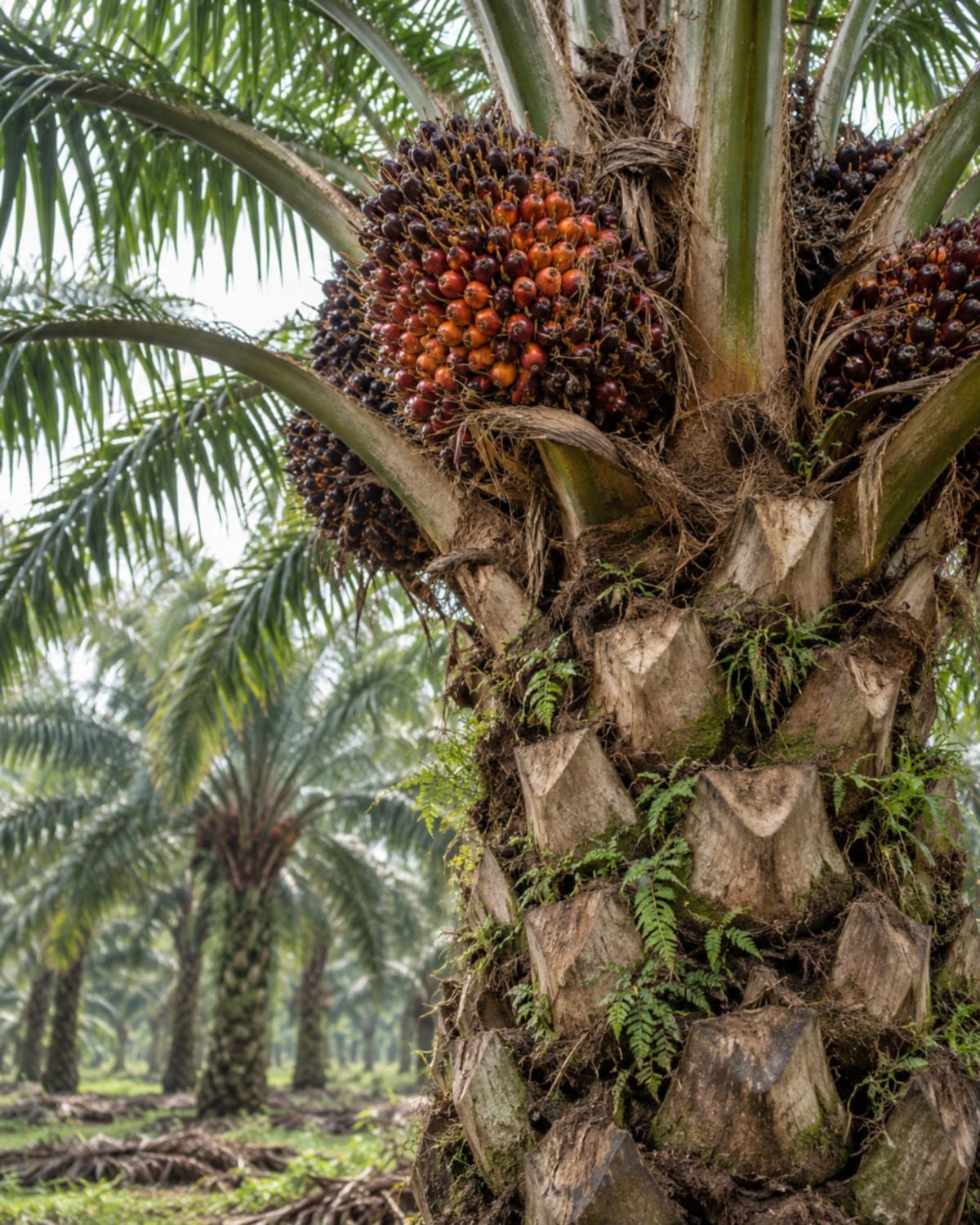
Industrial · Single-stemmed perennial palm

Oil palm

Elaeis guineensis · Kelapa sawit · Arecaceae

A perennial palm harvested in short rounds once it starts bearing at 3 to 4 years. Basal stem rot (Ganoderma) is the main long-term threat, so sanitation at replanting matters most. Recycling fronds and empty fruit bunches and keeping a ground cover protect the soil.

  • Humid tropics
  • Tree crop

Summary of cited sources. TERAknow summarises published guidance from the sources linked on each page. Recommendations are general, not guaranteed: results depend on your soil, climate and variety, so confirm with local extension staff or an agronomist before acting.

Key facts

Site and soil at a glance

Soil
Deep, moist, loamy soil with good water permeability[1]
Soil pH
4 to 6[1]
Spacing
9 m triangular; about 140 palms/ha[1]
First harvest
3 to 4 years after planting[2]
Harvest round
Every 7 to 10 days[3]
Ripeness
At least one loose fruit has fallen[4]
Soil pH band: 4.0 to 6.0
Good practice

Practices by growth stage

Pick a stage, topic or approach to narrow the list. Open a card for technical detail and its sources.

Growth stage
Topic
Approach

Showing 11 of 11 practices.

    • Core practice
    • Pests & disease
    • Stage: Replanting & land preparation

    Remove old stumps and roots at replanting

    Ganoderma survives in old palm tissue and can infect the new crop. Dead or rotting trunks and leftover rubber stumps are likely sources, so destroy them during land clearing.

    Technical detail
    • PPKS field trials: root sanitation with big-hole planting delayed infection until about 2 years after treatment, and hole-in-hole planting suppressed disease up to 7 years.
    • The PPKS smallholder guide notes that dead trees left in the field also attract rhinoceros beetles.
    • Well-fed palms are less vulnerable to stem rot, so start nutrition early.
    Regions
    Indonesia
    Confidence
    High confidence: several institutional sources agree
    • Biological & regenerative
    • Pests & disease
    • Stage: Mature palms

    Mound infected palms with Trichoderma and trench off hotspots

    No method fully cures basal stem rot. Digging out rotten tissue and mounding soil with Trichoderma can extend the productive life of an infected palm, and a trench can slow spread to neighbours.

    Technical detail
    • PPKS: digging and mounding with Trichoderma extended the life of infected palms up to 3 years after treatment.
    • A 4 m x 4 m isolation trench prevented spread to neighbouring palms for up to 2 years in the same trials.
    • A 2022 review found Trichoderma the most studied biocontrol agent, but concluded no current method controls Ganoderma effectively. Treat it as slowing the disease, not curing it.
    Regions
    Indonesia · Malaysia
    Confidence
    Medium confidence: one institutional guide
    • Biological & regenerative
    • Soil biology
    • Stage: Replanting & land preparation

    Sow a legume cover crop at land preparation

    Legume covers reduce erosion, keep soil moist, limit loss of organic matter and attract natural enemies of pests. Sow once, after land clearing, avoiding very heavy rain or dry spells.

    Technical detail
    • Smallholder Oil Palm Handbook seed rates: Mucuna bracteata 200 to 300 g/ha; Pueraria phaseoloides 3 to 4 kg/ha; Calopogonium caeruleum 1 to 1.5 kg/ha. Most seed needs scarification (sandpaper or hot water).
    • The same guide supports establishment with soluble P (for example 500 kg/ha TSP) or reactive rock phosphate. These are rates from one guide; adjust to a soil test.
    • Slash inter-row vegetation at knee height about every six months.
    • TNAU also lists Pueraria, Calopogonium, Centrosema and Mucuna; FELCRA uses legume covers during the immature stage.
    Regions
    Indonesia · Malaysia
    Confidence
    High confidence: several institutional sources agree
    • Core practice
    • Establishment
    • Stage: Replanting & land preparation

    Plant on a triangular grid in suitable soil

    A triangular layout at 9 m gives about 140 palms per hectare. Choose deep, moist, permeable loam with pH between 4 and 6.

    Technical detail
    • TNAU: triangular system 9 m x 9 m x 9 m; best planting season in Tamil Nadu is May to June.
    • TNAU gives a climate of 21 to 32 °C with relative humidity of 75 to 100%.
    Regions
    India (Tamil Nadu) · Widely applicable
    Confidence
    Medium confidence: one institutional guide
    • Conventional
    • Crop care
    • Stage: Immature palms

    Ablate early inflorescences in young palms

    TNAU recommends removing all inflorescences monthly for the first three years so young palms put energy into growth.

    Technical detail
    • First harvest under the TNAU schedule is about 3.5 to 4 years after planting.
    • The TNAU nursery dose is 8 g of 15:15:6 NPK in 5 L of water per 100 seedlings. This is from one guide; adjust locally.
    Regions
    India (Tamil Nadu)
    Confidence
    Medium confidence: one institutional guide
    • Conventional
    • Soil & nutrition
    • Stage: Mature palms

    Feed by the 4R rule: type, rate, time, place

    Fertiliser rates should replace what the harvest removes. PPKS estimates each tonne of fresh fruit bunches removes about 3 kg N, 4 kg K, 0.4 kg P and 0.6 kg Mg.

    Technical detail
    • PPKS: split rates above 2 kg per tree, and split urea above 1 kg per tree. Avoid heavy rain, waterlogged fields and very hot, dry spells.
    • Place compound and P, K and Mg fertilisers on the spread fronds; put urea and borate in the weeded circle. Keep dolomite at least one month apart from K fertiliser.
    • TNAU gives fixed per-palm schedules split into two doses a year. These are from one guide; base rates on soil and leaf analysis.
    Regions
    Indonesia · India (Tamil Nadu)
    Confidence
    High confidence: several institutional sources agree
    • Biological & regenerative
    • Soil biology
    • Stage: Mature palms

    Stack pruned fronds around each palm

    Pruned fronds returned to the field feed the soil, hold moisture, reduce erosion and suppress weeds. Lay them in a U or C shape, leaving only the palm circle and harvest path open.

    Technical detail
    • PPKS: keep the circle and path at about 1.5 m radius, widening to 2.5 m for tall palms.
    • Smallholder handbook: chop the cut frond in two; put the thick spiny part on the stack between rows and the thin part between neighbouring palms.
    • Over-stacked fronds can shelter rats, so spread them rather than piling them.
    Regions
    Indonesia
    Confidence
    High confidence: several institutional sources agree
    • Biological & regenerative
    • Soil & nutrition
    • Stage: Mature palms

    Spread empty fruit bunches one layer thick

    Empty fruit bunches (EFB) from the mill are rich in potassium and add organic matter. In a 15-year Riau trial, topsoil organic carbon was higher under EFB than under fertiliser alone.

    Technical detail
    • Smallholder handbook: 30 to 40 t/ha can replace K, P, Mg and B fertiliser for about a year, but keep applying N. PPKS gives 35 to 40 t/ha for estates, 70 to 80 t/ha on sandy soils and as little as 10 t/ha for smallholders. Adjust to a soil test.
    • Lay EFB in a band beside the frond stack or in patches between palms, not in the weeded circle of mature palms.
    • Keep the layer one bunch thick and turn patches to check for rhinoceros beetle larvae.
    Regions
    Indonesia · Malaysia
    Confidence
    High confidence: several institutional sources agree
    • Core practice
    • Crop care
    • Stage: Mature palms

    Keep enough green fronds when pruning

    Fronds feed the bunches. Prune to keep a set number of green fronds and avoid over-pruning.

    Technical detail
    • PPKS: palms up to 8 years keep 48 to 56 fronds (about 3 below the last bunch); older palms keep 32 to 48 (about 2 below the last bunch). Below 32 fronds can reduce yield.
    • TNAU gives similar numbers: 48 to 56 leaves at 4 to 7 years, falling to 32 to 40 after 15 years.
    • Under-pruning and long harvest intervals favour bunch rot and bunch moth.
    Regions
    Indonesia · India (Tamil Nadu)
    Confidence
    High confidence: several institutional sources agree
    • Biological & regenerative
    • Pests & disease
    • Stage: Mature palms

    Keep light ground cover and flowering plants for natural enemies

    Bare soil from heavy herbicide use removes the plants that support beneficial insects, which can lead to pest outbreaks.

    Technical detail
    • PPKS targets clean palm circles and paths with light vegetation between palms.
    • Beneficial flowering plants such as Turnera and Antigonon support insects that prey on leaf-eating pests.
    Regions
    Indonesia
    Confidence
    Medium confidence: one institutional guide
    • Core practice
    • Harvest
    • Stage: Harvest rounds

    Harvest by loose fruit, every 7 to 10 days

    A bunch is ripe when at least one loose fruit has dropped. Bunch colour alone is unreliable. Short, regular rounds avoid overripe bunches and lost loose fruit.

    Technical detail
    • Smallholder handbook: harvest every 7 to 10 days; two-week rounds are common but leave overripe bunches. PPKS allows up to 15 days in low-crop periods and advises against 20 days or more.
    • Unripe bunches contain little oil and trigger mill deductions.
    • Get bunches to the mill fast: the handbook sets 24 hours; the 2003 Ministry of Agriculture guide advises within 8 hours, because free fatty acids rise after harvest.
    Regions
    Indonesia
    Confidence
    High confidence: several institutional sources agree
Regional notes

How practice differs by region

  • Indonesia (smallholders)

    The PPKS pocket guide sets the loose-fruit ripeness rule, U or C frond stacking and 4R fertiliser planning, with EFB at lower rates where supply is short.

  • Malaysia

    MPOB published a standard operating procedure for basal stem rot in 2025. Its content was not reviewed here. FELCRA recommends legume covers and EFB mulch.

  • Research gap

    Peat and coastal soils

    Water-table, subsidence and nutrient guidance for oil palm on peat still to be added.

Common mistakes

What to avoid, and what to do instead

  • AvoidLeaving old palm trunks and rubber stumps to rot at replanting.
    InsteadRemove and destroy old tissue and roots before planting.
  • AvoidCutting bunches that have no loose fruit.
    InsteadWait for at least one loose fruit, or shake the bunch to check.
  • AvoidHarvesting every 20 days or more.
    InsteadKeep rounds to 7 to 10 days.
  • AvoidOver-pruning to fewer than 32 green fronds.
    InsteadKeep the frond numbers set for the palm's age.
  • AvoidPiling empty fruit bunches in thick heaps.
    InsteadSpread one bunch thick and check for beetle larvae.
Sources

Numbered sources

This page summarises the sources below. Check the original documents for full context.

  1. Oil palm (Elaeis guineensis): Horticulture, plantation crops (opens in a new tab)TNAU Agritech Portal, Tamil Nadu Agricultural University (year not stated)
  2. Pedoman Teknologi Pengolahan Kelapa Sawit (opens in a new tab)Direktorat Pengolahan dan Pemasaran Hasil Perkebunan, Departemen Pertanian RI, 2003
  3. Smallholder Oil Palm Handbook Module 2: Harvesting, Grading, Transport (3rd ed.) (opens in a new tab)Woittiez L.S., Sadikin H., Turhina S., Dani H., Dukan T.P., Smit H.; SNV and Wageningen University, 2016
  4. Pocket Guide Book: Indonesian Oil Palm Smallholders (bilingual) (opens in a new tab)Rahutomo S., Pradiko I., Farrasati R., Syarovy M.; PPKS (IOPRI) with Nebraska Extension, University of Nebraska, 2023
  5. Pengendalian Penyakit Busuk Pangkal Batang Kelapa Sawit secara Kultur Teknis (opens in a new tab)Priwiratama H., Prasetyo A.E., Susanto A. (PPKS Medan); Jurnal Fitopatologi Indonesia 10(1), 2014
  6. Basal stem rot of oil palm incited by Ganoderma species: A review (opens in a new tab)Supramani S. et al.; European Journal of Plant Pathology 164(1), 2022
  7. Sustainable Oil Palm Farming / Establishing a ground cover (Smallholder Oil Palm Handbook Module 3) (opens in a new tab)Woittiez L.S. et al.; SNV and Wageningen University, 2016, via Akvopedia
  8. Good Agricultural Practices (opens in a new tab)FELCRA Berhad, Malaysia (year not stated)
  9. Sustainable Oil Palm Farming / Applying empty fruit bunches (opens in a new tab)Smallholder Oil Palm Handbook (SNV and Wageningen University), via Akvopedia (year not stated on page)
  10. Long-term crop residue application maintains oil palm yield and temporal stability of production (opens in a new tab)Tao H.-H., Snaddon J.L., Slade E.M., Caliman J.-P., Widodo R.H., Suhardi, Willis K.J.; Agronomy for Sustainable Development 37:33, 2017
THE NEXT STEP
LET'S CULTIVATE PROGRESS

Better soil starts
with better decisions.

Turn soil insights into practical action, from testing to targeted improvement.