
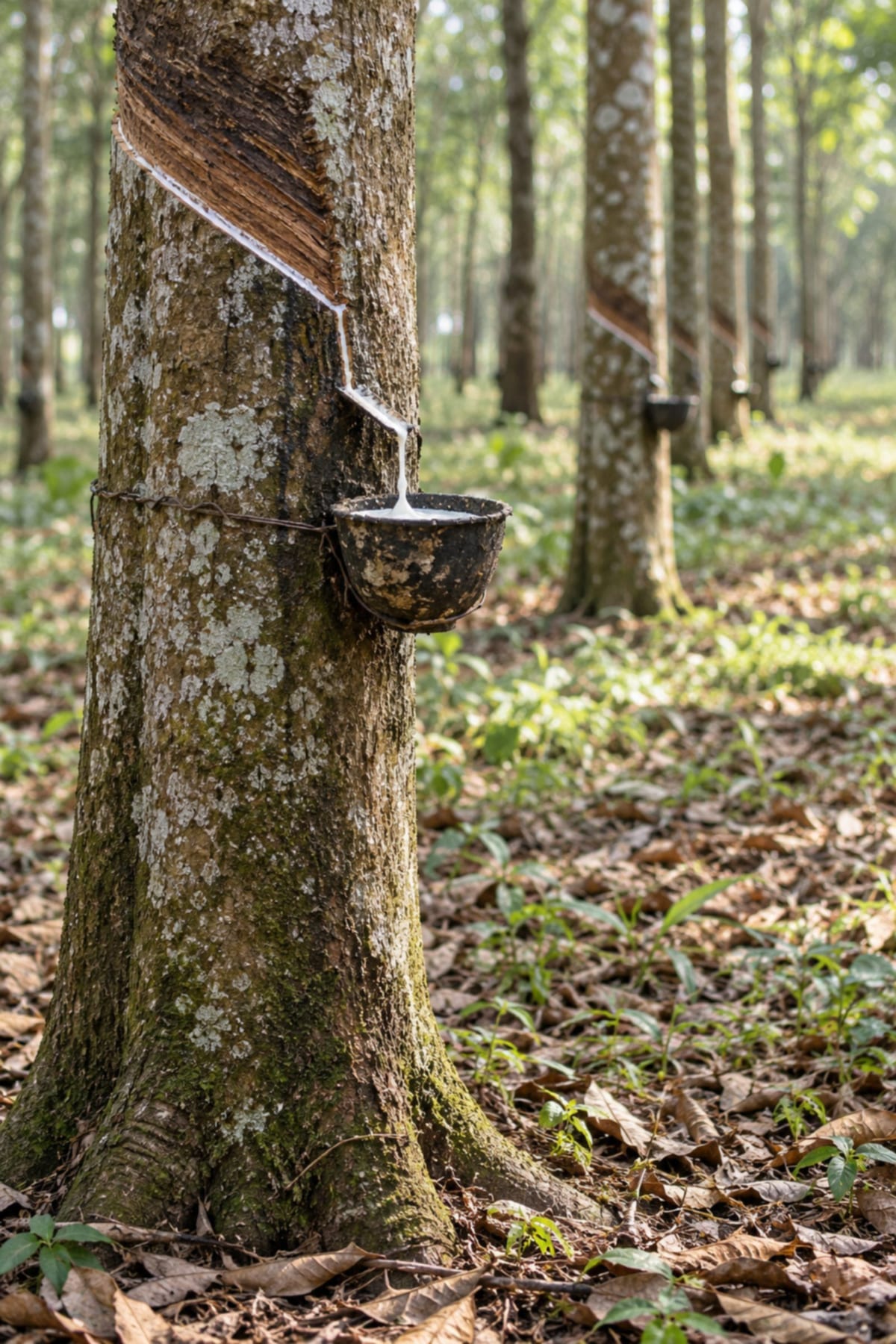
Industrial · Perennial tree, about 28 years of tapping

Rubber

Hevea brasiliensis · Karet · Euphorbiaceae

A long-lived plantation tree grown from budded clones. The first five years decide stand quality, and tapping discipline decides yield and tree life after that. White root disease is a major risk where old stumps are left in the ground.

  • Humid tropics
  • Tree crop

Summary of cited sources. TERAknow summarises published guidance from the sources linked on each page. Recommendations are general, not guaranteed: results depend on your soil, climate and variety, so confirm with local extension staff or an agronomist before acting.

Key facts

Site and soil at a glance

Rainfall
2,000 to 4,500 mm per year[1]
Temperature
25 to 34°C; humidity around 80%[1]
Soil
Deep, fertile, lateritic; pH 4.5 to 6.0[1]
Density
About 420 to 445 budded trees/ha[1]
Open for tapping
At 50 cm girth, 1 m above ground[2]
Avoid
Sites exposed to strong winds[1]
Soil pH band: 4.5 to 6.0
Good practice

Practices by growth stage

Pick a stage, topic or approach to narrow the list. Open a card for technical detail and its sources.

Growth stage
Topic
Approach

Showing 14 of 14 practices.

    • Core practice
    • Establishment
    • Stage: Budding

    Plant budded clones, not unselected seedlings

    Commercial rubber is propagated by budding a selected clone onto a seedling rootstock. Clones give more uniform and productive stands than local seedlings.

    Technical detail
    • Budding methods include green, brown and crown budding.
    • In Indonesian agroforestry trials, clones such as PB 260, RRIC 100 and BPM 1 were compared with local seedlings.
    • Choose clones recommended for your region by the national rubber research institute.
    Regions
    Widely applicable · Indonesia
    Confidence
    High confidence: several institutional sources agree
    • Core practice
    • Pests & disease
    • Stage: Land prep & planting

    Remove old stumps and roots before replanting

    White root disease (Rigidoporus microporus) is most damaging where many old root stumps and woody debris are left. Young trees aged 2 to 6 years are most at risk.

    Technical detail
    • Clear and destroy old roots and stumps during land preparation.
    • Remove and burn infected roots from affected trees.
    • A three-year-old tree can die within six months of infection, so check young trees regularly.
    Regions
    Indonesia · Widely applicable
    Confidence
    Medium confidence: one institutional guide
    • Conventional
    • Soil & nutrition
    • Stage: Land prep & planting

    Prepare large pits with compost and rock phosphate

    Fill planting pits with topsoil and compost, and add rock phosphate because these acidic soils are often short of phosphorus.

    Technical detail
    • Pit size about 1 m³.
    • Per pit: 12 kg compost or farmyard manure and 120 g rock phosphate before planting.
    • Spacing on plains about 4.9 × 4.9 m (about 420 trees/ha); on hills 6.7 × 3.4 m (about 445 trees/ha).
    Regions
    India (Tamil Nadu)
    Confidence
    Medium confidence: one institutional guide
    • Biological & regenerative
    • Soil biology
    • Stage: Land prep & planting

    Establish a legume cover crop between rows

    Creeping legumes protect the soil between young trees, suppress weeds and add nitrogen and organic matter.

    Technical detail
    • Common species: Pueraria phaseoloides, Calopogonium mucunoides, Centrosema pubescens and Desmodium ovalifolium.
    • Keep the cover weeded and clear of the tree rows while trees are small.
    Regions
    Widely applicable
    Confidence
    Medium confidence: one institutional guide
    • Biological & regenerative
    • Soil biology
    • Stage: Immature growth

    Rubber agroforestry for smallholders

    Indonesian 'jungle rubber' grows rubber with timber, fruit trees and annual crops in several layers. Improved systems keep this mix but use recommended clones.

    Technical detail
    • Over 80% of Indonesia's rubber area is smallholder land, much of it in mixed systems.
    • Reported benefits: income from several products, biodiversity, water conservation and carbon storage.
    • Trade-off: published yield and income comparisons with monoculture are limited, so returns need checking locally.
    Regions
    Indonesia
    Confidence
    Medium confidence: one institutional guide
    • Conventional
    • Soil & nutrition
    • Stage: Immature growth

    Split fertilizer in two doses a year

    Feed young and tapped trees in two split doses timed with the rains, and correct magnesium where it is short.

    Technical detail
    • Tapped trees: NPK 10:10:10 at about 900 g per tree per year, in two doses.
    • Where magnesium is deficient, add 10 kg magnesium sulphate per 100 kg of mixture.
    • Timing in the guide follows the Indian monsoon; match it to local rainy seasons.
    Regions
    India (Tamil Nadu)
    Confidence
    Medium confidence: one institutional guide
    • Core practice
    • Harvest
    • Stage: Tapping

    Open trees only when they reach tapping girth

    Start tapping when the trunk is 50 cm in circumference at 1 m above the ground, which is usually about five years after planting.

    Technical detail
    • The cut slopes down at about 30 degrees from the horizontal.
    • Cut close to the cambium without touching it; FAO describes stopping about 1.5 mm short of it.
    • When the panel has been tapped down its full length (about 7 years), tapping restarts higher up. FAO describes about 28 years of harvest in total.
    Regions
    Widely applicable
    Confidence
    High confidence: several institutional sources agree
    • Core practice
    • Harvest
    • Stage: Tapping

    Tap at daybreak and keep latex clean

    Latex flows best early in the morning; FAO notes that late-day tapping gives about a third less latex. Collect latex a few hours after tapping and keep cups clean.

    Technical detail
    • Collect cup contents about 4 hours after tapping.
    • Remove dried latex from the cut and bark, and clean cups regularly.
    • Tap each tree on a fixed schedule, and rest trees in the driest months.
    Regions
    Widely applicable
    Confidence
    High confidence: several institutional sources agree
    • Conventional
    • Crop care
    • Stage: Tapping

    Choose a tapping system and limit stimulation

    Low-frequency systems such as half spiral every third day (S/2 d/3) reduce tapping intensity. Ethephon stimulation can be used, but not continuously.

    Technical detail
    • Ethephon: 5% active ingredient brushed on a 5 cm strip below the cut after light scraping.
    • TNAU advises not using stimulation continuously for more than 3 years.
    • If trees show tapping panel dryness (brown bast), reduce intensity or rest them for 3 to 12 months.
    Regions
    India (Tamil Nadu) · Widely applicable
    Confidence
    Medium confidence: one institutional guide
    • Biological & regenerative
    • Soil biology
    • Stage: Immature growth

    Trichoderma against white root disease

    Local Trichoderma isolates from Indonesia slowed the white root fungus in the lab and reduced disease on potted stumps.

    Technical detail
    • Four of 16 isolates reduced fungal growth by 66 to 71% in the lab.
    • Trials were on potted stumps; field results are not yet established.
    • Use alongside stump removal, not instead of it.
    Regions
    Indonesia (North Sumatra)
    Confidence
    Emerging evidence: early or small-scale evidence
    • Core practice
    • Establishment
    • Stage: Budding

    Plant budded material of a recommended clone

    Indonesian rules call for clonal planting material: a recommended clone bud-grafted onto rootstock from a certified seed garden.

    Technical detail
    • Ministry of Agriculture guide (2014) latex clones: IRR 104, IRR 112, IRR 118, IRR 220, BPM 24, PB 260, PB 330, PB 340. Latex-timber clones: IRR 5, IRR 39, IRR 42, IRR 107, RRIC 100. This list covers the 2010 to 2014 period.
    • Older clones such as GT 1, PR 255, PR 261, RRIM 600 and RRIM 712 may still be used depending on site and target.
    • Rootstock seed should come from seed gardens with at least 95% clone purity. Buy budded stumps or polybag plants with no more than two leaf whorls.
    Regions
    Indonesia
    Confidence
    Medium confidence: one institutional guide
    • Core practice
    • Establishment
    • Stage: Land prep & planting

    Plant at 500 to 600 trees per hectare

    The Ministry guide sets ideal density at 500 to 600 trees/ha, with layouts that suit intercropping.

    Technical detail
    • Spacing options: 3 x 6 m, 4 x 5 m or 3.3 x 5.5 m. For intercropping use 3 x 6 m, with the 6 m rows running north to south.
    • Planting holes at least 40 x 40 x 40 cm.
    Regions
    Indonesia
    Confidence
    Medium confidence: one institutional guide
    • Conventional
    • Harvest
    • Stage: Tapping

    Match tapping frequency and stimulant to clone type

    The Rubber Research Institute separates quick-starter clones (such as PB 260 and IRR clones) from slow-starter clones (such as BPM 24, PR 255, GT 1). They need different stimulant use.

    Technical detail
    • The standard system in that review is S/2 d3 with ethephon 2.5%. Quick starters respond less to stimulant and are prone to tapping panel dryness, so stimulant is limited (the text says at most 12 times a year). Slow starters can take stimulant up to 18 times a year, twice a month.
    • Moving to d4 cut tapping days from 100 to 75 a year and cut costs, but lowered output of quick-starter clones by about 20%. S/2 d6 was not recommended because returns did not cover costs.
    • The authors suggest d4 for slow-starter clones south of the equator when prices are low, and using latex diagnosis to keep trees healthy.
    Regions
    Indonesia
    Confidence
    Medium confidence: one institutional guide
    • Conventional
    • Harvest
    • Stage: Tapping

    Use clones that hold yield under low-frequency tapping

    Not every clone copes with tapping every fourth day. Institute trials name clones that do relatively well, and give stimulant timing for d4.

    Technical detail
    • Sayurandi (2020): d3 still out-yielded d4 overall, but PB 330, IRR 104, IRR 220 and RRIM 901 gave comparatively high yields under 1/2S d4 with 2.5% ethephon.
    • For BPM 24 on S/2 d4 with 2.5% ethephon every two weeks, applying stimulant 45 hours before tapping worked best in one Getas trial, the same timing advised for d3.
    • New clones IRR 309 and IRR 310 (2025) respond strongly to ethephon, resist Corynespora and Colletotrichum leaf fall and can be opened at 4.5 to 5 years. They still need the right tapping system.
    Regions
    Indonesia
    Confidence
    Medium confidence: one institutional guide
Regional notes

How practice differs by region

  • Indonesia

    Mostly smallholder land, much of it in mixed 'jungle rubber'. ICRAF and CIRAD trials test improved agroforestry with clones (Wibawa et al.).

  • India (Kerala, Tamil Nadu)

    Prophylactic copper sprays before the southwest monsoon against abnormal leaf fall; defined fertilizer schedules (TNAU).

  • Research gap

    Indonesian clone recommendations

    The fetched Ministry of Agriculture guide (2014) lists IRR 104, IRR 112, IRR 118, IRR 220, BPM 24, PB 260, PB 330 and PB 340 as latex clones and IRR 5, IRR 39, IRR 42, IRR 107 and RRIC 100 as latex-timber clones, for 2010 to 2014. The Rubber Research Institute released IRR 309 and IRR 310 in 2025. Tapping advice from the institute centres on S/2 d3 with 2.5% ethephon, with d4 as a labour-saving option for slow-starter clones. The current official recommended clone list for 2021 onward and the tapping-start criteria (girth, opening height) from the Ministry guide could not be read in fetched text.

Common mistakes

What to avoid, and what to do instead

  • AvoidReplanting without clearing old stumps and roots.
    InsteadRemove stumps and woody debris to reduce white root disease.
  • AvoidOpening trees before they reach 50 cm girth.
    InsteadWait for tapping girth, even if it takes longer than planned.
  • AvoidCutting into the cambium.
    InsteadTrain tappers to stop just short of it; wounds reduce future bark renewal.
  • AvoidTapping late in the morning.
    InsteadTap at daybreak when latex flow is highest.
  • AvoidTapping on through panel dryness or over-stimulating.
    InsteadLower intensity or rest the trees, and limit ethephon use.
Sources

Numbered sources

This page summarises the sources below. Check the original documents for full context.

  1. Rubber (plantation crops) (opens in a new tab)Tamil Nadu Agricultural University, TNAU Agritech Portal, India
  2. Tapping means (rubber latex harvesting) (opens in a new tab)FAO
  3. Rubber based agroforestry systems: options for smallholders (opens in a new tab)Wibawa, Joshi, van Noordwijk & Penot, ICRAF / CIRAD, 2008
  4. An assay on potential of local Trichoderma spp. to control white root rot disease caused by Rigidoporus microporus in rubber plant stump (opens in a new tab)Suryanto et al., Journal of Pure and Applied Microbiology 11(2), 2017
  5. Pedoman Budidaya Karet (Hevea brasiliensis) yang Baik (annex to Permentan No. 132/Permentan/OT.140/12/2013) (opens in a new tab)Ministry of Agriculture, Directorate General of Estate Crops, 2014
  6. Optimalisasi Produksi dan Penekanan Biaya Penyadapan dengan Sistem Sadap Intensitas Rendah (opens in a new tab)Sumarmadji, A. Rouf, Y.B.S. Aji, T. Widyasari; Balai Penelitian Getas, Pusat Penelitian Karet, Warta Perkaretan 36(1), 2017
  7. Evaluasi Kinerja Klon Karet Unggul dengan Penerapan Sistem Sadap Intensitas Rendah (opens in a new tab)Sayurandi; Balai Penelitian Sungei Putih, Pusat Penelitian Karet, Warta Perkaretan 39(1), 2020
  8. Respon Hasil Panen Lateks Tanaman Karet Klon BPM 24 terhadap Perbedaan Waktu Aplikasi Stimulan pada Frekuensi Sadap D4 (opens in a new tab)M.O. Nugrahani, A. Rouf; Balai Penelitian Getas, Pusat Penelitian Karet, Warta Perkaretan 41(2), 2022
  9. Pengembangan Klon Karet Unggul Baru IRR 309 dan IRR 310 Responsif terhadap Stimulan Etefon (opens in a new tab)F. Oktavia et al.; Pusat Penelitian Karet, Warta Perkaretan 44(1), 2025
THE NEXT STEP
LET'S CULTIVATE PROGRESS

Better soil starts
with better decisions.

Turn soil insights into practical action, from testing to targeted improvement.